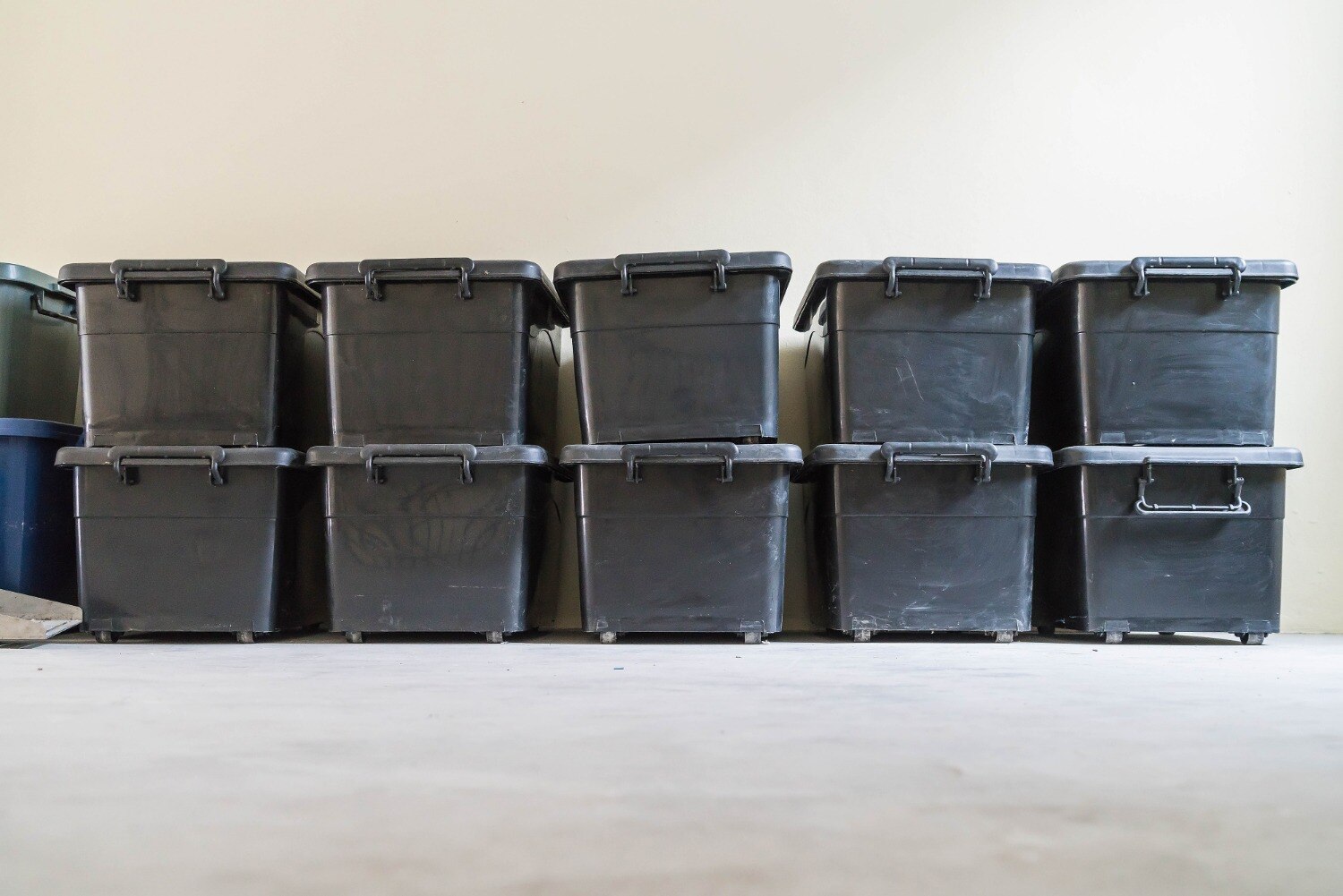
Choosing an ESD box by the words “anti-static” alone can leave sensitive parts unprotected, create grounding problems, or produce cells that do not fit the actual components. You will be able to compare material classes, verify electrical test evidence, design practical divider layouts, and specify a box for storage, EPA use, or transport before requesting a quotation.
Key takeaways
- Match the box material to charge control, dissipation, grounding, or shielding needs.
- Request surface resistance, triboelectric charging, and test-condition evidence from the supplier.
- Check divider clearances against component dimensions, handling space, and box capacity.
- Approve a loaded sample before comparing price, construction, and delivery terms.
Which ESD material class fits your application?
Choose the material class by deciding whether you need reduced charge generation, controlled charge dissipation, grounding, or shielding.
| Class | What it means | When it fits |
|---|---|---|
| Anti-static | Usually reduces charge generation; it is not a complete ESD protection system. | General handling where rubbing must create less charge. |
| Dissipative | Commonly 1.0 × 10⁴ to below 1.0 × 10¹¹ ohms. | Controlled EPA storage when gradual charge release is sufficient. |
| Conductive | Commonly below 1.0 × 10⁴ ohms. | Grounded workstations or bonded storage where rapid charge removal is required. |
| Non-conductive | Insulates and can retain charge on its surface. | Ordinary storage, not unprotected ESD-sensitive devices. |
Conductive boxes need a defined grounding path or equipotential bonding; conductivity alone does not remove charge. A dissipative or non-conductive box also does not shield components from an external discharge during trucking, warehousing, or export handling outside an EPA. Use a qualified shielding bag or overpack when transport protection is required.
For anti static storage containers in pune and anti static boxes for electronics in pune, ask for:
- Surface-resistance ranges for the assembled box and dividers
- Conditioning humidity, test date, test method, instrument, and measured values
- Charge-generation or charge-decay evidence when parts slide, rub, or are removed
- The specified limits and grounding requirement
IEC 61340-5-1 frames an ESD control programme, ANSI/ESD S20.20 defines programme requirements, and IEC 61340-2-3 covers resistance and resistivity measurement. Define “ESD-safe” in the purchase order using measurable limits, shielding requirements, and test standards.
What electrical evidence should you request from a Pune supplier?
Request evidence for the assembled box-and-divider system, not a generic “ESD-safe” claim from an esd storage box supplier in Pune.
1. Obtain a product datasheet naming the polymer, conductive additive or surface treatment; box and divider resistance ranges; and whether those values apply to the complete assembled unit, including ribs, handles, lid and partition inserts.
2. Require a test report identifying the instrument, electrodes, applied voltage, conditioning temperature, relative humidity, sample identification, measured values and test standard. Evidence from a resin pellet or flat sheet does not prove a moulded box performs correctly.
3. Ask how the supplier measures charge generation or charge decay when parts will be rubbed, slid, inserted or removed. Validate the actual cleaning agent and wiping method because oil, dust, labels, abrasion and aggressive solvents can change surface behaviour.
4. For conductive items, specify the grounding path and resistance-to-ground limit. Contact with an ESD bench alone is not evidence of grounding.
5. For reusable anti static storage containers in Pune, record lot traceability, re-test intervals, acceptable resistance drift and replacement criteria. Require the purchase order to state the resistance, charge, shielding and test-standard requirements.
J-STD-033 controls still apply to moisture-sensitive devices. An ESD container does not replace a moisture-barrier bag, desiccant, humidity indicator card or floor-life control when the component’s moisture sensitivity level requires them. Include these checks in the approval record before accepting the sample.
How should you design dividers and check the fit?
Fit the divider grid to the component’s maximum handling envelope, not its catalogue dimensions. Measure length, width, height, lead overhang, connector latch, PCB edge, cable bend radius, reel flange, and the bagged or tray-packed condition.
1. Add clearance for insertion, finger access, retrieval tools, cushioning, and thermal expansion. Record usable internal length, width, and height below the lid or stack shoulder; external dimensions cannot confirm fit.
2. Specify cell count, divider pitch, and divider thickness. Identify fixed moulded walls, removable inserts, or an adjustable slot system, then confirm that dividers lock into the base, reach full height, and prevent parts sliding into neighbouring cells when the box tilts.
3. Match the cell to the part. Bare PCBs need edge support and separation so solder joints and board surfaces do not rub. ICs and sensors need small, stable cells with controlled retrieval access. Connectors need clearance around latches and pins.
4. Give cables longer cells with bend allowance. Use shallow, countable compartments for screws and fasteners so sizes cannot mix.
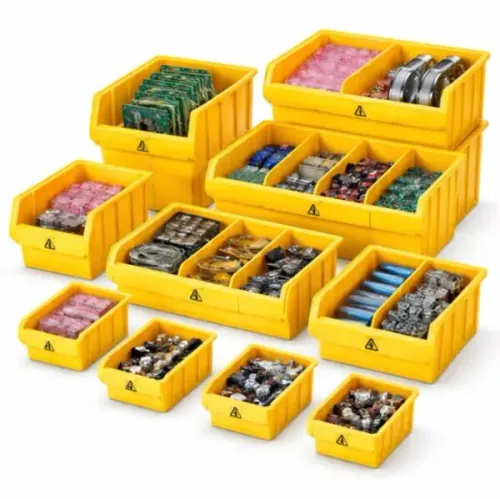
For esd bin partition boxes in pune, treat the divider as part of the ESD system, not an ordinary insert. Confirm its material, coating, contact with the box, and rubbing during removal; these details can change charge behaviour and resistance.
Ask suppliers of anti static storage boxes with dividers in pune for an internal-dimension drawing and a sample filled with the real component. Test insertion, retrieval, tilt, stacking, cleaning, and lid closure before approving production quantity.
Which construction and handling features affect daily use?
A box that looks adequate at its nominal capacity can fail when thin walls bow, dividers disengage, or the lid opens during movement.
Compare the polymer and moulding details, not colour alone: ask whether the body is injection-moulded polypropylene, a copolymer grade, or another polymer, then request its operating temperature range, chemical-resistance guidance, impact behaviour, and resistance to cracking after repeated stacking and handling.
| Feature | Lighter option | Reinforced option | Daily consequence |
|---|---|---|---|
| Wall and ribs | Thin wall, minimal ribs | Thicker wall with load-bearing ribs | Thin walls weigh less but can bow and release dividers |
| Lid | Snap closure | Positive latch, with optional transparent panel | A secure lid stays closed without pressing components; a clear panel aids identification |
| Base and stacking | Flat base, limited support | Stacking feet and reinforced base | Feet preserve cell space and improve stability under load |
Ask for label holders, barcode areas, handles, empty-box nesting, full-box stacking, rated stack load, base deflection, and rack-span limits. Confirm that the base does not block divider cells and that the box fits your rack, shelf, trolley, drawer, ESD workbench, or automated location.
For PCBs and long connectors, measure access height above the cell as well as its footprint. Test the packed arrangement for vibration, drop, compression, divider release, lid opening, and corner cracking; include the real mass, overpack, and closure.
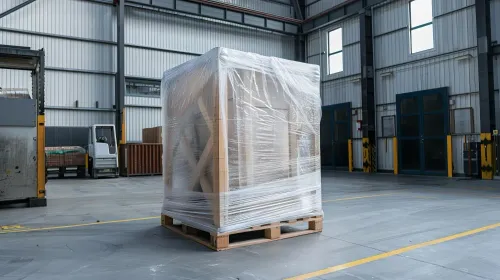
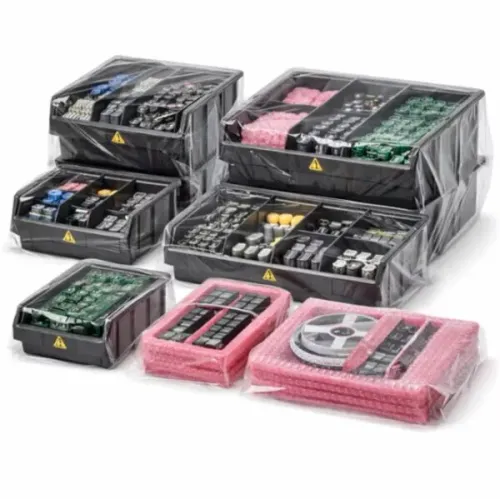
A small reusable bin can suit an EPA but fail in a truck or export case. Anti static boxes for electronics in Pune and anti static storage containers in Pune should pair dissipative containers with a qualified shielding bag or overpack outside the controlled area.
How can you compare a supplier quotation and approve the sample?
Approve the sample only after it passes the same loading, access, stacking and electrical checks that define the purchase.
Send each ESD storage box supplier in Pune one drawing and loading description covering component type, maximum dimensions, cell dimensions, divider pitch, quantity per box, lid, stack height, rack footprint, temperature, cleaning method, and whether the box remains inside an EPA or travels outside it.
Compare quotations on the same commercial dimensions:
| Quotation item | Require separately |
|---|---|
| Body | Box price, polymer, usable internal dimensions |
| Lid and dividers | Lid, divider sets, pitch, replacement availability |
| Identification | Labels, holders and traceability |
| Development | Sample tooling and custom mould changes |
| Logistics | Return-loop handling and outer export packaging |
Compare usable cells and documented ESD performance, not price per external box. Require the pre-production sample to contain the actual PCB, IC, connector, sensor, cable, reel, tray, bag or fastener.
- Tilt the loaded box: parts must not cross cells, and dividers must not release.
- Reach the lowest part without crushing leads, pins or cable bends.
- Close the lid without touching the load; lift and stack a full box without instability.
- Measure the complete box and dividers after the specified cleaning method and after representative rubbing and insertion cycles.
Ask the supplier for resistance results, test limits, handling limits, lot traceability and a transport plan. Anti-static storage boxes with dividers in Pune may suit internal EPA handling yet need a shielding overpack outside it.
OM INDIA can be compared with local manufacturers when custom partitions, export packaging or heavy-cargo protection is part of the requirement.
Related products
 | ESD Bin Partition Boxes Anti-Static Storage Boxes with Dividers Manufacturer & Supplier in Pune, Pimpri Chinchwad & Mumbai OM INDIA is a trusted manufacturer and supplier of Anti-Static Storage Boxes with... View product → |
 | ESD Bin Partition Boxes Manufacturer & Supplier in Pune, Pimpri Chinchwad & Mumbai OM INDIA is a trusted manufacturer and supplier of ESD Partition Boxes, designed for safe... View product → |
Frequently asked questions
Which ESD material class fits an anti-static storage box application?
Choose reduced-charge-generation material for basic protection, dissipative material for controlled charge release, conductive material for grounding, or shielding material when external electrostatic fields threaten sensitive devices.
What electrical evidence should you request from a Pune ESD box supplier?
Request the material’s surface resistance or resistance-to-ground results, test method, test conditions, sample identification, and any triboelectric charging or shielding test data relevant to your application.
How should you design dividers for ESD storage boxes?
Measure the component length, width, height, connector clearance, and handling space, then check every divider position with loaded samples before approving the layout.
Which construction features affect daily use of anti-static storage containers?
Compare wall stiffness, rim strength, divider retention, stackability, lid fit, label areas, cleanability, lifting access, and resistance to repeated handling.
How can you compare an ESD storage box quotation and approve the sample?
Compare material class, electrical evidence, dimensions, divider layout, load rating, tooling, minimum order quantity, lead time, packaging, and test-sample performance before placing the order.
Related products
 | ESD Bin Boxes Manufacturer & Supplier in Pune, Pimpri Chinchwad & Mumbai OM INDIA is a trusted manufacturer and supplier of PCB Storage ESD Bin Boxes, specially... View product → |
 | ESD Bin Partition Boxes Manufacturer & Supplier in Pune, Pimpri Chinchwad & Mumbai OM INDIA is a trusted manufacturer and supplier of ESD Bin Partition Boxes, designed for... View product → |
 | ESD Bin Boxes Manufacturer & Supplier in Pune, Pimpri Chinchwad & Mumbai OM INDIA is a trusted manufacturer and supplier of ESD Bin Boxes, designed to safely... View product → |
 | ESD Bin Boxes Manufacturer & Supplier in Pune, Pimpri Chinchwad & Mumbai OM INDIA is a trusted manufacturer and supplier of Non-Conductive ESD Bin Boxes, designed... View product → |
Keywords