A perimeter base pallet is stable only when its runners, deck, fork entries, and restraint points match the cargo and the way handlers will move it. By the end, you will know which dimensions and load ratings to request, how to select a footprint, how to restrain the load, and how to verify export compliance before dispatch.
Key takeaways
- Match runner spacing to the cargo’s heaviest contact points.
- Put pallet rating, cargo dimensions and lifting clearances on the drawing.
- Choose a footprint that supports the load without creating unstable overhangs.
- Approve blocking, strapping, treatment marks and final load condition before dispatch.
How perimeter-base construction carries a wide or concentrated load
The outer runners form a continuous rectangle and carry load as primary structural paths, not as cosmetic edge boards. Deck boards span between these perimeter members and any intermediate runners; without enough support, a concentrated equipment foot can bend a board locally.
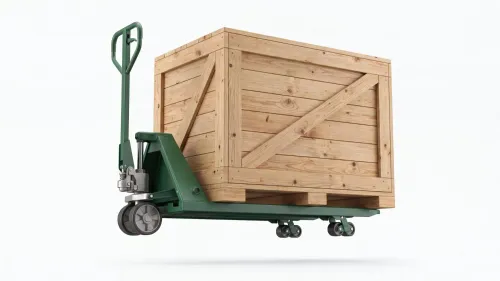
The underside leaves planned channels for forklift forks and pallet-jack wheels, while runner height and spacing determine entry clearance.
| Pallet type | Load-path arrangement | Practical difference |
|---|---|---|
| Perimeter-base pallet | Continuous outer runners plus intermediate runners | Supports wide equipment at its edges and distributes loads into the base |
| Block pallet | Individual blocks connected by deck and bottom boards | Offers multi-direction entry, but block positions must match concentrated loads |
| Stringer pallet | Long parallel stringers beneath the deck | Entry follows stringer openings; unsupported deck edges can deflect |
| Open-boarded pallet | Deck boards with limited underside support | Suits lighter, distributed cargo rather than wide or point-loaded equipment |
For a first design discussion about perimeter base pallets in pune, map the centre of gravity, deck-board span, lifting points and fork-entry direction before fixing runner locations.
Floor storage applies near-continuous support; forklift or pallet-jack handling creates bending between forks; crane lifting adds reactions at lifting points, while container movement adds vibration, braking and racking forces. Nominal outside dimensions do not establish capacity: deck thickness and spacing, runner sections, fasteners, wood condition and the support arrangement determine the safe load.
A wide machine needs edge support, and a pallet that survives on a floor can fail across forks or narrow rack beams.
Which pallet ratings and cargo measurements belong on the purchase drawing
A safe working load is valid only against a named support condition. Floor-supported cargo can pass while the same concentrated load deflects the deck between forklift tines or collapses across narrow rack beams. If you buy perimeter base pallets in pune, put separate ratings for each condition on the drawing.
| Condition | Rating to request | Failure risk to check |
|---|---|---|
| Static floor storage | Safe working load on continuous floor support | Deck crushing or local deflection beneath concentrated feet |
| Dynamic forklift or pallet-jack handling | Safe working load during lifting, turning, braking, and set-down | Runner bending, fork-pocket damage, or shifting cargo |
| Racking or beam support | Safe working load across the stated beam spacing | Runner failure or deck collapse between beams |
List every dimension and construction detail needed to verify those ratings:
- Pallet tare weight; cargo length, width, mass, footprint, contact points, centre of gravity, lifting points, bottom clearance, and maximum permitted overhang.
- Deck-board thickness and spacing, base height, fork-entry dimensions, runner sections, fastener pattern, wood grade or acceptance condition, and the intended forklift or pallet-jack type.
- Fork-pocket clearance, strap and blocking positions, stacking condition, and rack beam spacing.
- State allowable moisture condition or an equivalent acceptance criterion. Wet or unstable timber can shrink, cup, loosen fasteners, and change dimensions during monsoon storage and ocean transit.
- Show the cargo’s bearing points against the runners and deck boards; a “heavy-duty” label without this drawing cannot establish capacity.
How to choose the export footprint and stop the load from shifting
Choose the footprint from the shipment plan, not from convention. ISO 6780 standardizes principal pallet dimensions, but it does not make 1200 x 800 mm correct for every export load.
| Footprint | Strength | Check before choosing |
|---|---|---|
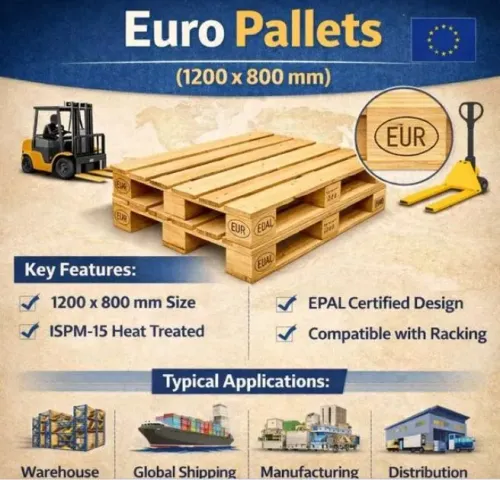
| 1200 x 800 mm Euro | Efficient for compatible European handling systems | Container cube, door opening, aisle width, racking beam spacing, forklift and customer equipment |
| 1200 x 1000 mm | More bearing area for broad equipment | Cargo overhang, container fit and centre-of-gravity position |
| 1100 x 1100 mm | Square support for balanced machinery | Customer handling systems, rack layout and fork-entry direction |
| Project-specific | Aligns supports and restraints to the actual load | Dimensioned cargo footprint, contact points, lifting points and clearance |
A 1200 x 800 mm pallet can waste container space, block a warehouse aisle, overhang its runners, or place a top-heavy load’s centre of gravity outside the support area. Confirm the customer’s pallet system before fixing the size.
Apply restraint in this order:
- Use timber chocks and saddles for shaped equipment.
- Tie blocking into the runners.
- Bolt through designed bearing points, never thin sheet or unsupported deck boards.
- Add strapping with edge protection.
- Use stretch film for containment, not positive restraint.
- Place anti-slip material at contact surfaces.
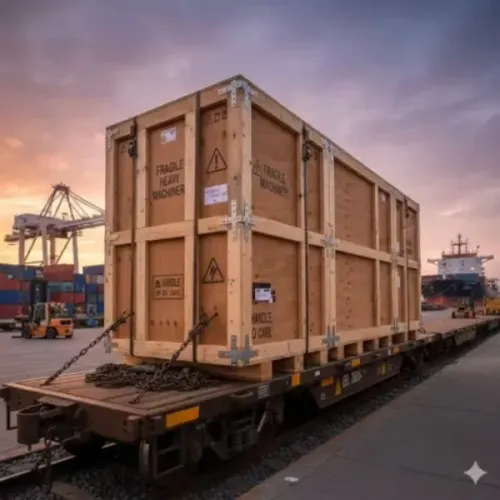
Choose a framed skid or crate instead of a pallet for tall, top-heavy, fragile, or vibration-sensitive equipment. For a custom perimeter pallets near me quotation, provide a dimensioned load drawing showing mass, centre of gravity, footprint, lifting points, fork clearance, overhang, tie-down and blocking locations, and handling equipment.
What export treatment and complete packing protection require
A pallet supports weight; complete export packing controls vibration, tipping, moisture, corrosion, and repeated handling. Blocking, bolting, saddles, chocks, and a framed base transfer forces into the runners. Stretch film and strapping provide containment, not positive restraint against braking, turning, vibration, or vessel movement.
For export pallets in Pune, verify the packing system against this checklist:
- Specify blocking, bolting, saddles, chocks, or a framed base for the cargo shape and centre of gravity. Add a moisture barrier, desiccant, or VCI protection when humidity or corrosion threatens the equipment.
- Require ISPM 15 treatment for solid-wood pallets, skids, dunnage, crates, and load boards. Wood must be heat-treated and debarked, reaching 56 °C at the coldest wood core for at least 30 continuous minutes.
- Check every wood-packaging component for a legible IPPC mark showing the country code, producer or treatment-provider code, and HT treatment code. An invoice statement or certificate does not replace the mark.
- Treat plywood, OSB, and fibreboard as generally exempt from this treatment-and-marking requirement, while confirming the destination rule before substituting them.
- Ask the carrier and importing-country agent to review damaged, incomplete, or rejected marks; consequences include treatment, re-export, destruction, or delay.
- Ask a supplier such as OM INDIA to provide the drawing, treatment status, marking details, blocking plan, and trial-build evidence together. “Export” alone is not a compliance guarantee for industrial export pallets in Pune.
Related products
 | Export & Customized Pallets Manufacturer & Supplier in Pune, Pimpri Chinchwad & Mumbai OM INDIA is a reliable manufacturer and supplier of Perimeter Base Pallets, designed for... View product → |
 | Export & Customized Pallets Manufacturer & Supplier in Pune, Pimpri Chinchwad & Mumbai OM INDIA is a trusted manufacturer and supplier of Export & Customized Pallets, offering... View product → |
How to approve the loaded pallet before it enters the supply chain
Approve the loaded pallet against the shipment’s actual failure modes, not one static load figure. Match compression testing to deck deflection and stacking performance, then add fork-entry bending, impact, vibration, or restraint testing when those risks exist.
| Test | Failure examined | Approval evidence |
|---|---|---|
| Compression | Deck or stacked-load collapse | Deflection and damage stay within the specified limit |
| Fork-entry bending | Runner or joint failure during lifting | No permanent distortion after entry from each intended side |
| Impact or vibration | Loosening during road, crane, or sea movement | Cargo remains restrained and fasteners stay secure |
Build one complete trial unit with the actual cargo, blocking, fasteners, straps, and edge protection. Insert forks from every intended side; check underside clearance, lifting balance, protruding fasteners, corner damage, and strap-edge crushing. Confirm the cargo is not relying on deck boards alone. Move the loaded unit through the planned container door and warehouse aisle.
Compare delivered cost, not pallet price alone. Include:
- Pallet tare, blocking, fasteners, treatment, marking, and packing labour
- Lost container cube, rework, handling damage, and delay exposure
Record cargo mass, centre of gravity, support scenario, stacking condition, overhang tolerance, lifting points, tie-down locations, and handling equipment on the drawing. A “heavy-duty” quotation is approvable only when those inputs produce a testable design.
Frequently asked questions
How does a perimeter-base pallet support a wide or concentrated load?
Its continuous outer runners carry load around the perimeter, while deck boards and intermediate runners distribute force beneath wide or concentrated contact points.
What belongs on a perimeter pallet purchase drawing?
Specify the pallet’s rated load, overall dimensions, runner layout, deck-board thickness and spacing, cargo contact points, lifting clearances and handling equipment requirements.
How do you prevent export cargo from shifting on the pallet?
Select a footprint that supports the load, position the centre of gravity within the base, and use blocking, strapping and edge protection suited to the cargo.
What must be checked before a loaded export pallet enters the supply chain?
Confirm the pallet rating, export treatment mark, cargo restraint, protection against impact and moisture, lifting access, labels and final load stability.
Keywords