A machine can arrive damaged even when its total weight was within the skid’s rated capacity: an offset centre of gravity, narrow bearing area, loose rotor or poorly placed fork pocket can overload the package. You will be able to follow the design, restraint, moisture-protection and dispatch checks that turn a timber frame into a transport system suited to the machine and route.
Key takeaways
- Map the route, lifting points and handling equipment before cutting timber.
- Shape saddles to broad, strong bearing surfaces—not fragile covers or shafts.
- Calculate tipping and sliding forces, not just the machine’s gross mass.
- Add barriers, corrosion protection and a signed handover record before dispatch.
Start with the machine, route and handling plan
Do not cut timber until you know the machine, route and handling plan. A skid sized only by gross mass can fail when the load is tall, top-heavy or eccentric: braking and cornering then create tipping and sliding forces that a simple weight calculation misses.
1. Record the equipment length, width, height and gross mass. Mark the centre of gravity, lifting points, allowable support locations, axle or shaft diameter, protruding-part clearance and any fragile panels, guards, flanges or controls.
2. Confirm every transport mode: forklift, crane, truck or trailer, and the loading and unloading sequence. Check trailer deck limits, axle restrictions, route clearances and tie-down access. Pune road movement adds longitudinal forces during braking, lateral forces during cornering and repeated vertical shock from uneven roads.
3. Inspect the machine for loose assemblies, oil, moisture and existing damage. Inspect timber for loose bark, contamination, splits, decay and warping; reject defective members and clean every contact surface before assembly.
4. Prepare a dimensioned drawing before fabrication. Show bearing points, saddle locations, restraints, runner and cross-member positions, fork-entry openings, centre-of-gravity marking, crane sling or lifting-beam clearances, and clearance around shafts and protrusions.
5. Select the timber sections and connections from the drawing, not appearance. Ensure the support path carries the load without crushing or splitting, and specify blocking, chocks, bolts, straps or clamps to resist movement.
6. Perform a trial fit, then check fork access and crane lifting separately. A forklift-compatible skid is not automatically safe for crane lifting. This wooden saddle skid packaging process in Pune ends with photographs, dimensions and handling limits recorded before dispatch.
Match saddle geometry to the machine’s bearing surfaces
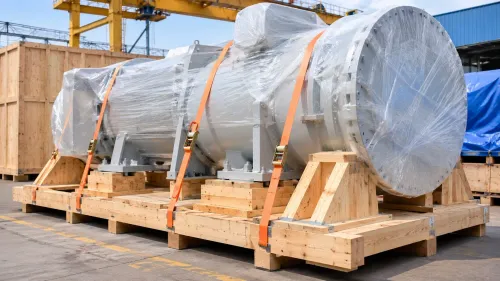
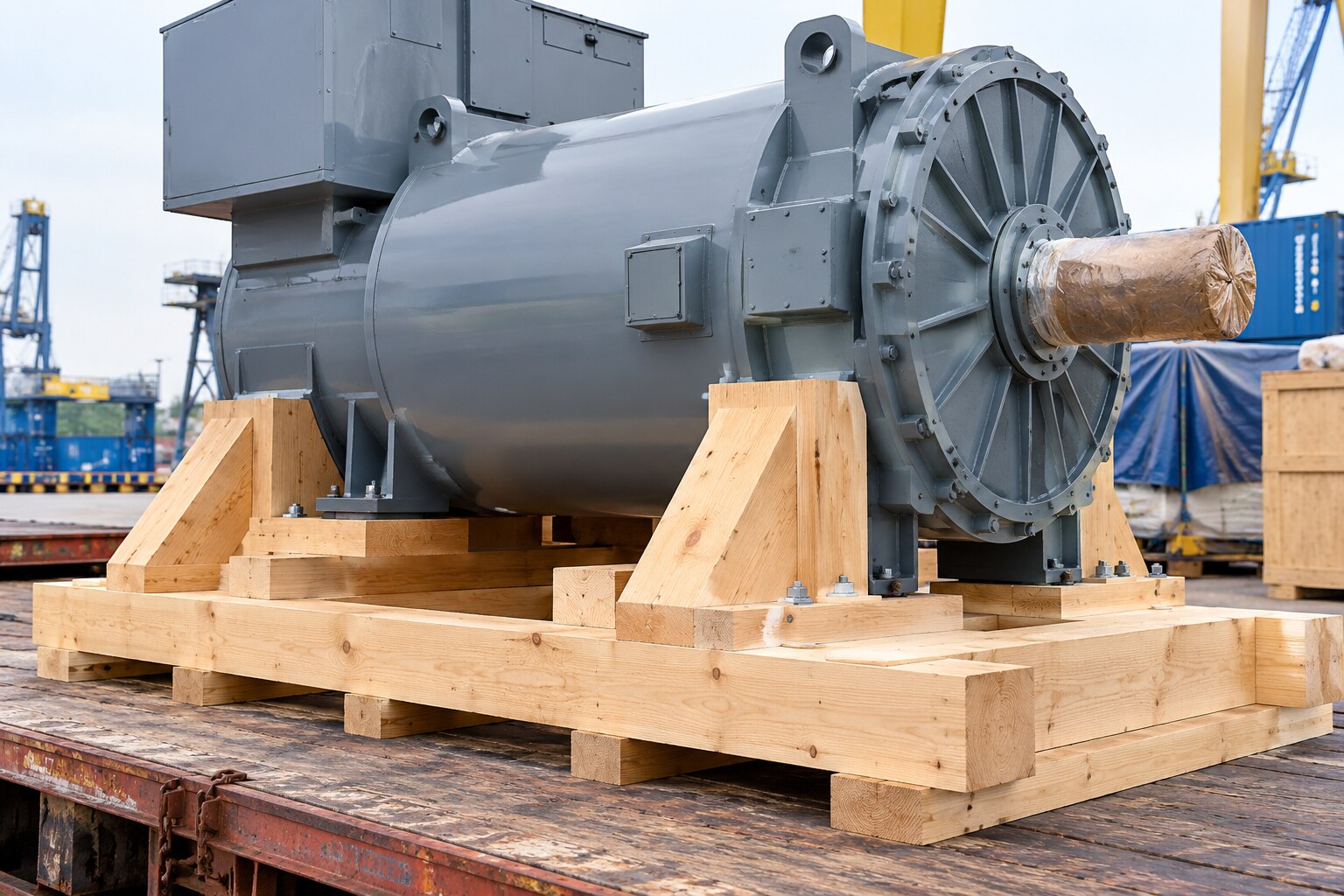
A shaped saddle prevents rolling by matching the machine’s cradle radius and holding the cylinder across a broad contact width, not at two sharp edges.
Set the support angle to keep the centre of gravity inside the saddle footprint during braking, cornering and lifting, while leaving clearance around flanges, couplings, valves, hydraulic lines and painted surfaces.
1. Place each bearing member under an approved structural area shown by the equipment maker. Never support a shaft, guard, housing or thin panel; these can bend or transmit damaging point loads even when the total machine weight is within the timber’s capacity.
2. Increase contact width with shaped timber packing, rubber liners or sacrificial pads where needed. These interfaces spread bearing pressure, reduce edge loading and prevent abrasion against machined or painted surfaces. The saddle must restrain rolling without clamping protruding parts.
3. Before assembly, inspect every timber member. Reject wood with loose bark, oil, soil or other contamination, splits, excessive knots or warping. Keep the bearing faces clean, and cover nearby electrical, hydraulic and machined surfaces so timber debris cannot enter or scratch them.
4. Confirm the profile against the actual equipment before fastening. In wooden saddle skid packaging in Pune, a radius that is too tight creates line contact; one that is too open allows rocking. Check fork and sling clearance separately, because a forklift-safe saddle is not automatically suitable for crane lifting.
Size the skid and choose the right packaging combination
Choose the package by bearing method, load path, handling equipment and exposure—not gross mass alone.
| Option | What it means | When it applies |
|---|---|---|
| Saddle | Shaped bearing interface that supports a cylinder or defined structural points | Use for round vessels, shafts or irregular bases |
| Skid | Longitudinal runners plus beams forming the load path and handling base | Use for concentrated, tall or eccentric machinery |
| Pallet | General-purpose flat platform | Use for compact, stable loads with a prepared base |
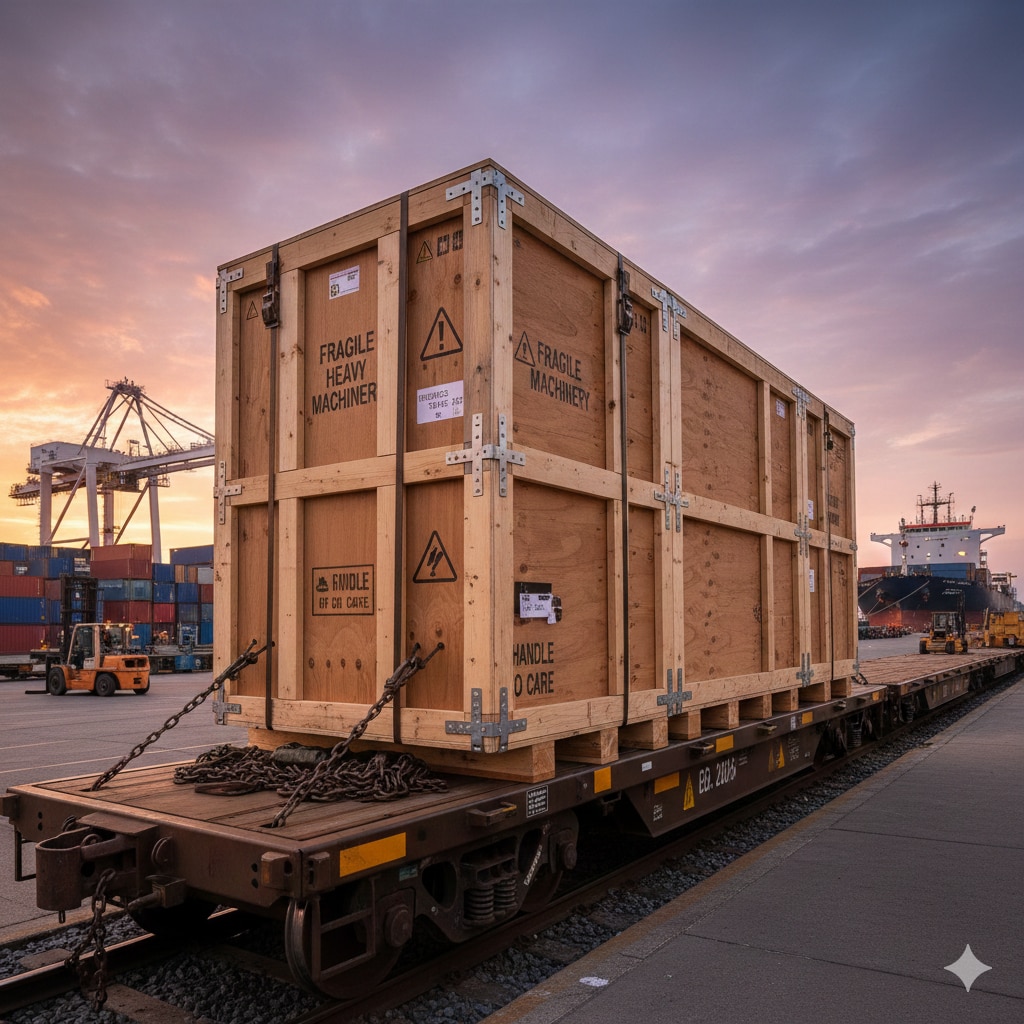
| Closed crate | Enclosure against impact, dust and weather | Use for fragile, exposed or export machinery |
Size runners and transverse beams for the allowable load of the specific machine, then check timber crushing at each bearing, splitting at fasteners, buckling under eccentric compression and connection capacity under braking and lifting.
Space cross-members beneath approved support points, keep deck height low, and make the footprint wide enough to surround the projected centre-of-gravity area. A tall or offset load needs wider runners, outriggers or anti-tip bracing, not merely thicker timber.
Provide fork-entry openings that fit the actual forks without striking the machine; forklift compatibility does not make a skid safe for crane lifting. Crane loads introduce sling angles, point loads and lateral forces, so use designated lifting lugs, a lifting beam or engineered lifting frame.
Mount a saddle on a skid when cylindrical equipment needs shaped support and a longitudinal handling base. Add a crate or barrier enclosure when projections, controls, machined surfaces or electrical parts need impact, dust or weather protection. Wooden skids for heavy equipment still need positive restraint; they do not prevent sliding or tipping by themselves.
Restrain every moving mass without damaging the machine
A skid can remain intact while the machine shifts, tips or suffers internal damage. In machinery saddle packaging near Pune, restrain the load for braking, cornering, vibration, crane lifting and uneven roads—not just for its static weight.
1. Block the main frame against movement with timber chocks and engineered blocking at approved structural points. Add steel straps, chains, threaded rods, steel angles, lag screws, structural screws or through-bolts as the load path requires.
Check withdrawal, shear, splitting, end distance and load transfer in both the timber and fasteners; nails alone are a poor assumption for heavy dynamic loads.
2. Protect every contact zone before tightening. Use liners, spacers and non-abrasive barriers between restraints and painted surfaces, shafts, flanges, machined faces, hydraulic components and electrical cabinets. Keep straps and chains clear of sharp edges, hoses, connectors and sealing faces.
3. Lock independent assemblies separately. Securing only the outer frame leaves a rotor, carriage, boom, table or other internal assembly free to move, causing impact damage during braking and vibration. Fit the manufacturer’s transport locks, or install engineered blocking that cannot contact vulnerable surfaces.
4. Mark the centre of gravity and keep tie-down points accessible to the crew. After tightening, check clearance around moving parts, flanges, valves, cables, lifting gear and the truck or trailer. Confirm that fork pockets, crane slings and restraints remain usable on uneven roads, then record the final inspection.
Add moisture, corrosion and handover controls before dispatch
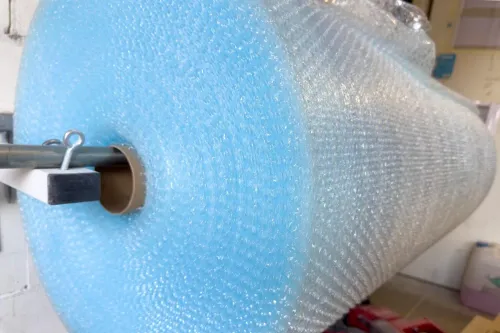
A timber saddle and skid provide structural support; they do not control humidity or corrosion. Before sealing, dry the machine and remove water from recesses, oil coolers and exposed machined surfaces. Wet equipment inside a moisture barrier traps moisture against metal.
1. Choose the environmental layer for the route and storage period. Use a vapour-barrier or sealed moisture-barrier enclosure for export, long transit or outdoor storage. Size desiccant for the enclosed volume and transit duration, then place a humidity indicator where it can be read after opening.
2. Add corrosion control when the metal and conditions require it. Use VCI paper, film, emitters or bags around clean, dry metal, but keep VCI material compatible with painted surfaces, rubber and electrical components. Do not treat VCI as a substitute for drying or sealing.
3. For export, inspect every skid, saddle and solid-wood dunnage piece for the official IPPC mark and obtain supplier documentation showing ISPM 15 compliance. ISPM 15 controls wood pests; it does not prove corrosion protection, restraint strength, impact resistance or water tightness.
4. Seal the handover pack with the shipment. Include equipment and package weights, dimensions, centre of gravity, lifting points, sling angles, forklift limits, photographs of restraints, treatment details and unpacking instructions.
For a domestic or export job, ask an industrial saddle packaging service in Pune, including OM INDIA, for the drawing, load calculations, route-specific handling plan and dispatch inspection. That evidence matters more than a timber frame’s appearance.
Related products
 | Wooden Crates, Saddles & Skids Manufacturer & Supplier in Pune, Pimpri Chinchwad & Mumbai OM INDIA is a trusted manufacturer and supplier of Wooden Saddles, specially designed for... View product → |
 | Wooden Crates, Saddles & Skids Wooden Crates, Saddles & Skids Manufacturer & Supplier in Pune, Pimpri Chinchwad & Mumbai OM INDIA is a trusted manufacturer and supplier of Wooden Crates, Saddles & Skids,... View product → |
Frequently asked questions
Why is gross machine weight insufficient for designing a wooden skid?
A skid must also handle tipping, sliding and uneven loading caused by the machine’s height, centre of gravity, eccentric mass, braking and cornering.
How do you match a wooden saddle to heavy machinery?
Place the saddle under strong, verified bearing surfaces and shape its contact face to support the machine without loading shafts, covers, seals or other fragile parts.
When should you combine a wooden skid with other packaging?
Use the skid with blocking, bolting or strapping, protective wrapping, corrosion control and a weather-resistant enclosure when the route or cargo requires those controls.
What should you check before dispatching saddle-packaged machinery?
Confirm restraint tension, lifting and forklift access, moisture protection, corrosion materials, package markings, photographs and signed handover documents.
Related products
 | Wooden Crates, Saddles & Skids Manufacturer & Supplier in Pune, Pimpri Chinchwad & Mumbai OM INDIA is a trusted manufacturer and supplier of Wooden Skids, designed for safe... View product → |
 | Wooden Crates, Saddles & Skids Customized Saddles for Cylindrical & Heavy Equipment Manufacturer & Supplier in Pune, Pimpri Chinchwad & Mumbai OM INDIA is a trusted manufacturer and supplier of Customized Saddles for Cylindrical &... View product → |
 | Customized & Special Packaging Solutions Manufacturer & Supplier in Pune, Pimpri Chinchwad & Mumbai OM INDIA is a trusted manufacturer and supplier of Heavy Equipment Packaging, designed to... View product → |
Keywords